
What the Diaspora Owes a Country It Left
Notes on grief, guilt, and the diaspora's unfinished job

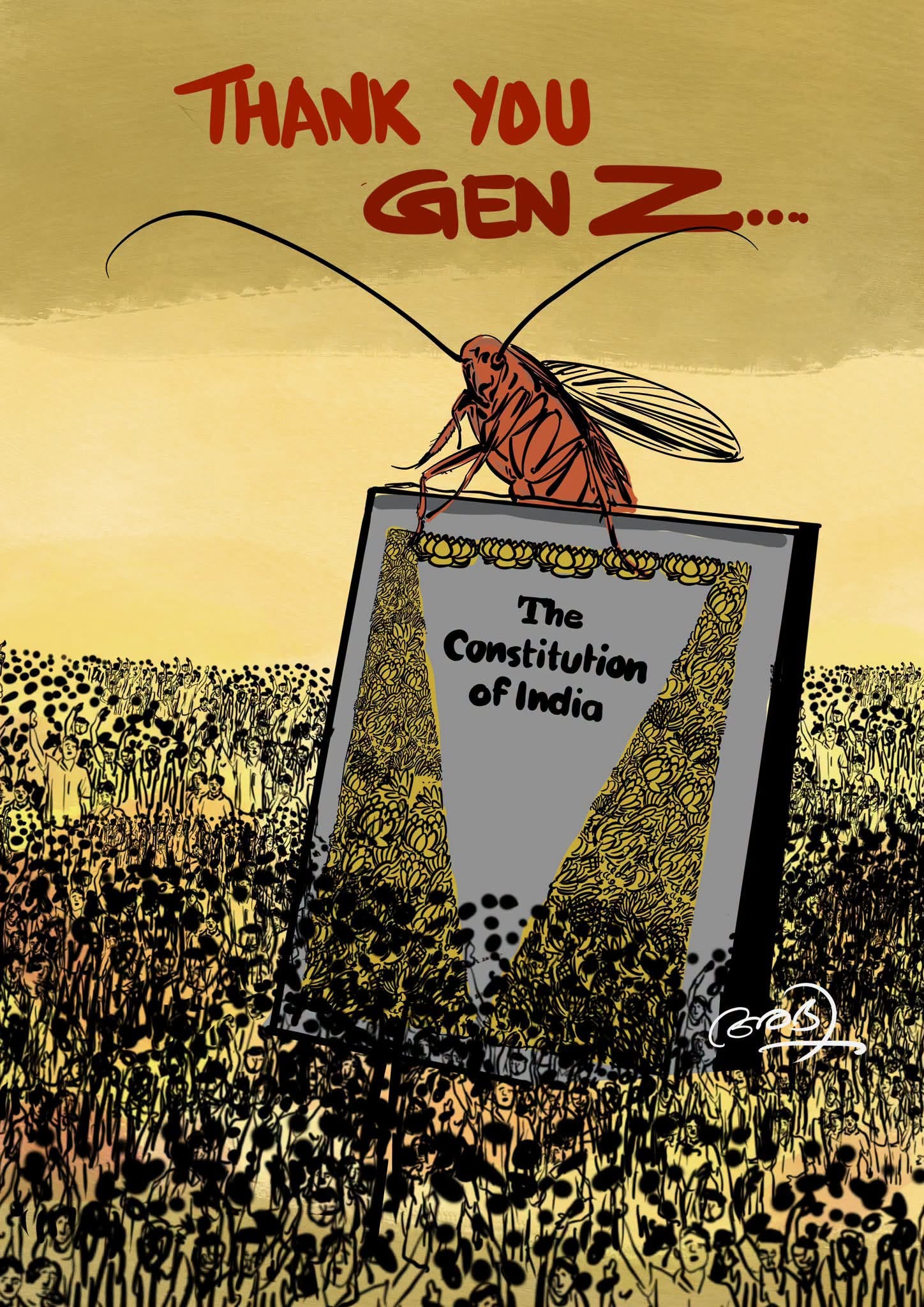
Illustration Credit: Abhilash Thiru, CC0, via Wikimedia Commons
My phone has barely left my hand this week. Sonam Wangchuk, wheeled into a hospital mid-hunger-strike. Boys in college t-shirts running from tear gas outside Parliament. A political party that started as a joke about cockroaches becoming the thing that finally rattled this government. The memes. The reels. The PM’s selfie video which was a jump scare. I refreshed and refreshed, and somewhere in Brisbane, the kettle boiled and I didn’t notice.
Then, this past weekend, Pradhan resigned. The CJP called off the protest. My phone filled up with people calling it a win, and I wanted to feel that too, cleanly, the way you’re supposed to feel about a win. Instead I sat there doing the math: the government has only promised compensation “wherever maximum possible,” not a number, not a name, and nobody has said what happens to the students who are still facing charges from getting beaten in the street. So I reshared the news with my hands a little unsteady. Earlier, on threads, I explained Jantar Mantar and CJP to people who’d never heard of it. I sent it to the family group chat. And when I closed my laptop, all I had to show for the whole thing was a slightly higher share count, and a body that hadn’t moved off the couch in hours.
Nobody tells you this part when you leave. You brace for the food you’ll miss, the light in the evenings, the specific sound of your mother’s voice on whatsapp calls. Nobody tells you you’ll also inherit a helplessness with no shape to it, watching your own country happen to itself in real time, caring with your whole chest, and having a retweet to show for it.
Why I Left
I was in the crowd for the anti-CAA protests in my city, not reading about them the next morning. Years before that I’d covered Telangana, when the state was tearing itself in two to become its own. Shaheen Bagh, clampdown on Kashmir, the Delhi riots, the migrant workers walking home with their children on their shoulders, the farmers on the highway for over a year, Manipur conflict, I filed on all of it for Suno India, on the phone at odd hours with reporters who were actually standing where I wasn’t. Podcast after podcast, it was the same shape wearing a different city’s name: people showing up, and the state deciding what to do about it- repress, censor and narrative war.
And then I left anyway. Two years ago now. Not because I got scared. Because there’s a kind of tired that has nothing to do with fear, the tired of watching people spend everything they have on a fight that doesn’t end, until you start to wonder what’s left in you to give it. I didn’t leave to escape that feeling. I just moved it somewhere else. Now it’s the specific, strange exhaustion of watching a movement happen in my own country for the first time in my adult life without me anywhere inside it.
The Privilege of Watching From a Distance
Here’s what nobody prepares you for: grief with the safety net still on. It doesn’t feel like grief. It feels like fury.
I watched the footage of the students getting caned and sat on my couch with my jaw so tight it ached, blinking hard, because some part of me still asks what right I have to cry about this from a country where nobody has ever raised a stick at me. So I didn’t cry. I yelled instead, mostly to my husband, the same three sentences on a loop while I refreshed my phone: they’re beating kids, they’re actually beating kids, and I’m just sitting here. I said it to friends over whatsapp chats, I thanked a GenZ friend for the courage of her generation. I said it again every day anyway, waking up everyday to look at news on instagram, because it was the only thing my body could still do. Not march. Not bleed. Just talk, and talk, and go quiet, and go to bed.
Distance doesn’t only keep you safe. It keeps you unaccountable, and that’s not a comfort, it’s a wound of its own kind. Two years ago I would have carried some sliver of what those kids carried on the road to Parliament. Now the only thing I carry is my own noise. My husband gets it. My friends get it. India gets a voice note and a couch that never moved. That’s the whole inheritance: the fury with nowhere left to land.
What Leaving Doesn’t Let You Skip
There’s a guilt underneath the fury too, quieter, meaner. The guilt of feeling almost relieved when a protest ends, because it means you don’t have to keep deciding how loudly to say something about it. The guilt of going quiet at a dinner party when someone starts talking about India’s growth story, because disagreeing costs more than it used to, and you’ve started rationing what you spend. None of that makes you a bad person. It just means you left, and leaving is a decision you keep making, every single day you don’t go back.
And still, this time, something moved that I didn’t expect. Sydney and Melbourne filled with Indian-Australians who showed up in solidarity. Outside the Indian High Commission in London, under a banner that said “Cockroaches of London Unite,” hundreds gathered, and it spread to Manchester and Leeds and Glasgow and Edinburgh, to Trafalgar Square and Oxford, where Greta Thunberg turned up too, of all people. Toronto and New York had their own small crowds outside their own consulates. A joke about cockroaches turned into something people across four continents decided was worth their Saturday. I won’t pretend that didn’t do something to me, watching a diaspora that mostly keeps its head down about home suddenly not keep its head down.
But a few days outside a consulate isn’t a commitment. It’s a reflex, and reflexes fade the moment the footage stops being ugly enough to demand one. The real work starts after the cameras leave: finding out if that compensation ever becomes an actual number, if those students actually stop facing charges, if anything underneath the story changes so this doesn’t happen again in eighteen months with different names. That kind of attention doesn’t make for a good photo outside a building with a flag on it. If tear gas is the only thing that gets us organised, we’re not in solidarity. We’re just reacting, the same as everyone else, and calling it something nobler.
The Ones Still Waiting, and the Screens That Failed Them
There’s a name I keep returning to that has nothing to do with this month’s news. Umar Khalid. His videos are now back up on instagram, doing the rounds, being heard and shared over and over again. Locked up since September 2020 without ever standing trial; Sharjeel Imam beside him the whole time. Both denied bail again in January, again in July, while men charged in the very same case walked free. Six years is not a wait for trial. It’s a sentence with no verdict attached.
I don’t know how to make that sound like anything other than what it is: a country finding it easier to lock up the people who spoke against hatred than to do anything about the hatred itself. Easier to convince everyone the protester was the danger than to explain what he was protesting. I’m not interested in turning this into heroes and villains, because that’s too clean a story for what actually happens, which is slower and uglier: neighbours turning on each other by inches, so slowly that by the time someone notices, a man’s been in a cell for six years and nobody quite remembers how it started.
I spent years inside a newsroom before I left it, so I get to say this without flinching: the fury people feel at Indian television is earned. Every bit of it. I watched primetime become a place where the point was never the truth, just the noise. I watched anchors decide who to blame before a single fact had landed. I watched channels call protesters traitors and activists terrorists before any court had ruled on anything at all. That’s not bias. Bias is a flaw. This was a choice, made over and over, camera after camera. I was part of that world, even while I tried to do something else inside it, and I still don’t know how to forgive it. People didn’t lose trust in the media. The media spent it, deliberately, night after night, until there was nothing left to spend.
What We Carry, Wherever We Are
The people still there carry it in their bodies, in the streets, at the vegetable stall, in twelve years of holding their breath without quite realising they’re doing it. The people who left carry something quieter but no lighter, guilt and distance and hands that never know what to do with themselves while the news plays. Neither version is easier. They’re just tired in different accents.
I used to think leaving meant I had nothing left to offer but that guilt, that the money I sent and the noise I made online were just me managing my own conscience and calling it help. Then I watched consulates in three different countries fill with people who could have just stayed home and felt quietly bad instead, and I watched a joke about cockroaches become something a government minister actually had to answer for, partly because the anger didn’t stop at any one border. That’s not everything. But it’s not nothing, either. It’s proof that the rope has more hands on it than I thought, even from here, even this far.
The exhaustion doesn’t go away. It’s real on both ends of it. But so is this: every time we show up loudly, and keep showing up, it gets a little harder for the people back home to be ignored. It isn’t a substitute for standing in that heat ourselves. It never will be. But if we can learn to turn up before the tear gas, not just after, there’s a version of this where what we hand each other, across all these time zones, is something other than exhaustion.
We are still, all of us, tired. The ones who stayed, and the ones who left. But this week, at least, we were also still showing up. Just from very far away.