

Stolen. Catalogued. On Display.
Inside the global system of cultural dispossession that most of us have been taught to call a museum.

On 9 July 2026, at a joint press conference in Melbourne, Australian Prime Minister Anthony Albanese and Indian Prime Minister Narendra Modi announced a reciprocal act of cultural restitution. Australia would return three ancient artefacts to India: a ceremonial bronze trident of the goddess Bhadrakali, a granite Nandi idol, and a six-headed Kartikeya sculpture, all dating to the 11th to 16th centuries and originating from temples in Tamil Nadu. In exchange, India would repatriate the ancestral remains of an Australian First Nations individual, held for decades at the Government Museum in Chennai.
Australian Minister for Indigenous Australians Malarndirri McCarthy described the moment plainly: “Every repatriation of ancestors from overseas is an act of truth-telling and righting wrongs of the past.”¹
She is right. But truth-telling, by definition, requires telling the whole truth. And the whole truth is this: the objects returned that day are not aberrations. They are a small fraction of a global system of cultural dispossession so vast, so entrenched, and so normalised that most of us have been taught to call it a museum.
The scale of what was taken
In 2018, French academics Felwine Sarr and Bénédicte Savoy published a landmark report commissioned by President Emmanuel Macron. Their finding was stark: over 90 per cent of sub-Saharan Africa’s cultural heritage is currently held outside the continent.² The Musée du Quai Branly in Paris alone holds more than 70,000 African objects. Belgium’s Musée Royale de l’Afrique Centrale holds an estimated 180,000 African artefacts. The British Museum holds approximately 69,000.³
The Benin Bronzes, thousands of sculptures looted by British troops in a single military expedition in 1897, are now scattered across as many as 160 museums worldwide.⁴ The Parthenon Marbles were removed from Athens by a British lord in the early 19th century and remain in London, despite decades of formal requests from Greece for their return.⁵ China’s Old Summer Palace was ransacked by British and French forces in 1860. Of the 12 original bronze zodiac fountain heads, seven have been successfully repatriated to China through high-profile auctions and donations, and are now housed at the National Museum of China and the Poly Art Museum in Beijing. The remaining five: the Dragon, Snake, Goat, Rooster, and Dog, are lost, their whereabouts unknown.⁶
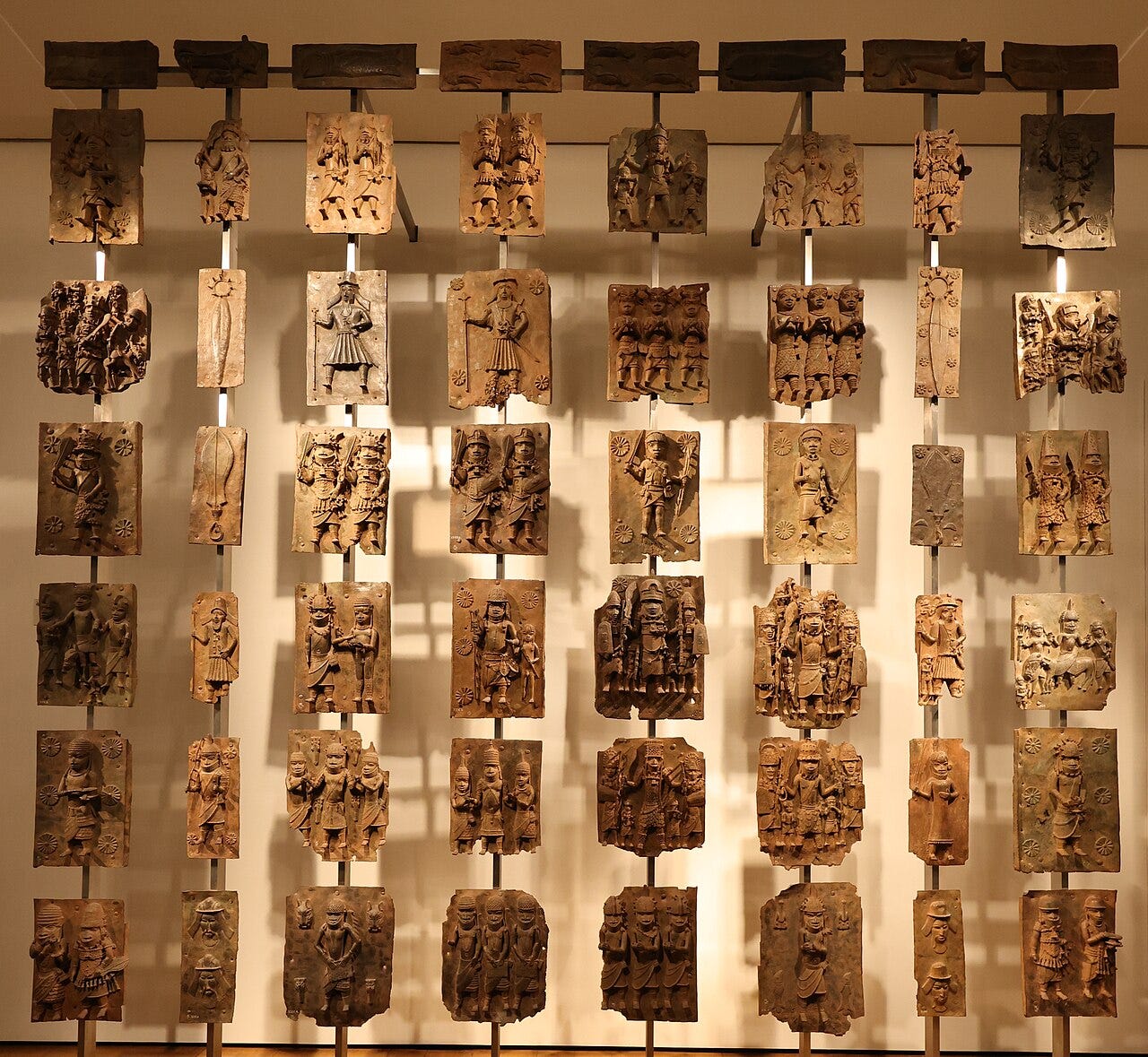
Benin Bronzes on display at the British Museum, London. Looted by British troops in 1897, the bronzes are scattered across as many as 160 institutions worldwide. The British Museum Act 1963 legally prevents their permanent return. (Image: Mike Peel / Wikimedia Commons, CC BY-SA 4.0)
These are not ancient accidents of history. They are the material consequences of a political project, colonialism, that understood the theft of culture as inseparable from the theft of land, labour and life. To possess another people’s sacred objects is to possess a claim over their identity. The museums of Europe and their offshoots were built, in significant part, on that logic.
Australia’s own reckoning
For over 300 years, Aboriginal and Torres Strait Islander cultural heritage — including ancestral remains — was removed and placed in museums, universities and private collections overseas.⁷ The taking of Indigenous bodily remains was not incidental to colonisation; it was a feature of it, driven by the pseudoscientific racism of the 19th century that treated First Nations people as specimens rather than human beings.
“It’s not just the items, it’s the spirit attached. They were taken. The people who once owned them, their spirit went with them and they returned today.”
— Murrandoo Yanner, Chairperson, Gangalidda Garawa Native Title Aboriginal Corporation
Australia’s government has supported international repatriation for over 40 years. Through the Office for the Arts’ Indigenous Repatriation Program and the AIATSIS-led Return of Cultural Heritage initiative, 1,789 ancestors have been returned from ten countries. Domestically, the program has returned more than 3,600 ancestors and over 2,300 secret sacred objects to their Traditional Custodians.⁸ This is meaningful work. It is also, given the scale of what was taken across three centuries, a beginning.
The exchange with India was notable precisely because it was not driven solely by Australia’s domestic reconciliation agenda. It was diplomatic — a bilateral gesture between two nations deepening their strategic partnership. That the return of a Tamil Nadu temple idol and the repatriation of an Indigenous elder’s remains could sit together on a diplomatic communiqué says something important: the world is slowly being forced to reckon with what its museums actually contain.
The arguments that keep stolen objects where they are
Western museums have long defended their holdings through what might be called the ‘universal museum’ doctrine: the idea that concentrating the world’s cultural heritage in a handful of major institutions makes it accessible to the broadest possible public. The British Museum is the most prominent exponent of this view. It is also, not coincidentally, legally prevented from permanently returning objects from its collection by the British Museum Act of 1963.⁹
This argument has several problems. First, it presupposes that the ‘universal public’ is primarily a Western one: that a person in London has more legitimate claim to access a Benin Bronze than a person in Benin City. Second, it ignores that many source communities have no access to their own heritage at all: over 60 per cent of sub-Saharan Africa’s young population, the majority of whom are under 20, have grown up in a world where their cultural inheritance exists, if at all, in photographs from museums they cannot afford to visit.¹⁰ Third, the argument assumes that objects are safer in Western hands. The Sarr-Savoy report notes that this premise was never questioned when the objects were first taken — often by force.
The more honest argument is a legal one: many of these objects were acquired under colonial legal frameworks that no longer exist, and international conventions like the UNESCO 1970 Convention and the Hague Convention are not retroactive.¹¹ This is true. It also does not resolve the moral question. Law and justice are not the same thing, and the history of decolonisation is largely the history of that distinction being made plain.
The momentum is shifting
The tide has been moving, even if slowly. Germany became the first nation to formally return Benin Bronzes in 2022. Cambridge University transferred ownership of over 100 Benin artefacts to Nigeria that same year. In June 2025, the Netherlands completed the largest single restitution in history, returning 119 Benin Bronzes to Nigeria in a ceremony attended by the Oba of Benin.¹² In 2024 alone, Ghana’s Manhyia Palace Museum received 67 restituted artefacts from institutions including the British Museum, the V&A, and UCLA’s Fowler Museum.¹³
Australia’s 2021 return of 14 artworks to India, including at least six believed to have been stolen or illegally exported, preceded the July 2026 announcement and set its precedent.¹⁴ The pattern is clear: bilateral relationships, diplomatic pressure, and the sustained advocacy of source communities are achieving what international law has not mandated.
But momentum is not resolution. The British Museum Act remains in force. The Elgin Marbles remain in London. The Quai Branly remains full. And the communities whose sacred objects sit behind glass in climate-controlled rooms in cities they may never visit continue to make the same argument they have been making for generations: these things belong to us. They were not given. They were taken.
What decolonising a museum actually means
Decolonising a museum is not, as its critics sometimes suggest, about emptying institutions or erasing history. It is about honesty: about provenance, about the conditions under which objects were acquired, about who gets to tell the story of what they mean. It is about recognising that a Nandi idol is not simply an ancient artefact — it is a sacred object, and its presence in a foreign museum is not a neutral fact of cultural exchange but the residue of an unequal encounter.
It means, concretely: conducting and publishing provenance research. Engaging source communities as partners rather than subjects. Creating genuine pathways for repatriation requests that do not require source countries to navigate the legal systems of their former colonisers. And in some cases, returning objects, not as diplomatic gifts, not as bilateral gestures, but as a matter of course.
The Australia-India exchange is a step. Framed as ‘mutual respect’ and ‘deepening cultural cooperation’, it is also, let’s be clear, the return of things that should not have been taken. The language of friendship is welcome. The return of the objects is what matters.
Murrandoo Yanner was speaking about the return of his ancestors. But the principle holds for a granite Nandi, a bronze trident, and the thousands of objects that remain. The spirit went with them. And it is past time for it to come home.
SOURCES & FOOTNOTES
1. Australian Minister Malarndirri McCarthy, statement, 9 July 2026, via IANS. https://ianslive.in/australia-to-return-cultural-artefacts-to-india-pm-modi-announces-repatriation-of-first-nations-ancestor--20260709133727
2. Sarr, F. & Savoy, B. (2018). The Restitution of African Cultural Heritage: Toward a New Relational Ethics. Commissioned by President Emmanuel Macron. Via Frieze: https://www.frieze.com/article/how-frances-restitution-report-unsettled-conversation-about-cultural-property
3. Comparison of African artefact holdings across European institutions. African History Extra, April 2025: https://www.africanhistoryextra.com/p/online-resources-for-african-history
4. The Art Newspaper global survey on Benin Bronzes, 2021. Bronzes scattered across as many as 160 institutions worldwide: https://torch.si.edu/wp-content/uploads/2021/05/The-Art-Newspaper-Global-survey-where-in-the-world-are-the-Benin-bronzes.pdf
5. British Museum and the Parthenon Marbles. Medium / Nuo Xu, March 2025: https://medium.com/@nxuu0014/can-museums-truly-be-decolonized-rethinking-their-role-in-a-post-colonial-world-794a6a39082d
6. Old Summer Palace looting, 1860, and status of zodiac heads. Ibid.
7. AIATSIS Return of Cultural Heritage program: https://aiatsis.gov.au/about/what-we-do/return-cultural-heritage
8. Repatriation figures: Routes to Return / AIATSIS: https://routestoreturn.com/australia/
9. British Museum Act 1963 prohibits permanent deaccessioning. MOMAA / Africa Repatriations Movement, February 2026: https://momaa.org/africas-stolen-art-is-coming-home-the-2026-reparations-movement-reshaping-global-museums/
10. Over 60% of sub-Saharan Africa’s population aged under 20. Sarr-Savoy report, via Frieze: https://www.frieze.com/article/how-frances-restitution-report-unsettled-conversation-about-cultural-property
11. UNESCO 1970 Convention and Hague Conventions are not retroactive. Young Professionals in Foreign Policy: https://www.ypfp.org/sub-saharan-africa-how-a-nations-heritage-remains-overseas/
12. Netherlands returns 119 Benin Bronzes, June 2025, largest single restitution. MOMAA, February 2026: https://momaa.org/africas-stolen-art-is-coming-home-the-2026-reparations-movement-reshaping-global-museums/
13. Ghana’s Manhyia Palace Museum receives 67 restituted artefacts in 2024. Ibid.
14. Australia returns 14 artworks to India, 2021, including six believed stolen. Gulf News: https://gulfnews.com/world/asia/india/australia-to-return-stolen-art-to-india-1.81054077